🌍 Nationality













“What we know is not capable of being otherwise; of things capable of being otherwise we do not know, when they have passed outsideour observation, whether they exist or not. Therefore the object of knowledge is of necessity. Therefore it is eternal; for things that are of necessity in the unqualified sense are all eternal; and things that are eternal are ungenerated and imperishable.”




“Salt water when it turns into vapour becomes sweet, and the vapour does not form salt water when it condenses again. This I know by experiment. The same thing is true in every case of the kind: wine and all fluids that evaporate and condense back into a liquid state become water. They all are water modified by a certain admixture, the nature of which determines their flavour.”


“Hence both women and children must be educated with an eye to the constitution, if indeed it makes any difference to the virtue of a city-state that its children be virtuous, and its women too. And it must make a difference, since half the free population are women, and from children come those who participate in the constitution.”





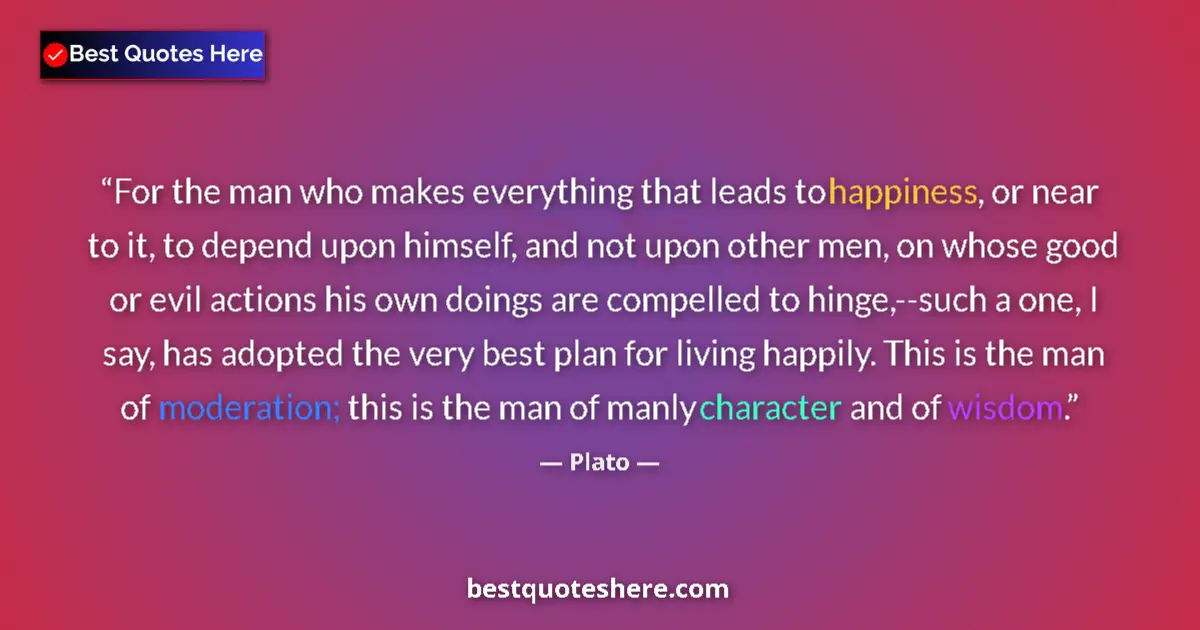
“For the man who makes everything that leads to happiness, or near to it, to depend upon himself, and not upon other men, on whose good or evil actions his own doings are compelled to hinge,--such a one, I say, has adopted the very best plan for living happily. This is the man of moderation; this is the man of manly character and of wisdom.”




![Quote by Aristotle: [Prudence] is the virtue of that part of the intel](https://media.bestquoteshere.com/quotes/en/aristotle-quotes/quote-33880-about-prudence-by-aristotle-facebook.webp)
“[Prudence] is the virtue of that part of the intellect [the calculative] to which it belongs; and . . . our choice of actions will not be right without Prudence any more than without Moral Virtue, since, while Moral Virtue enables us to achieve the end, Prudence makes us adopt the right means to the end.”


“Any one who has common sense will remember that the bewilderments of the eyes are of two kinds, and arise from two causes, either from coming out of the light or from going into the light, which is true of the mind's eye, quite as much as of the bodily eye; and he who remembers this when he sees any one whose vision is perplexed and weak, will not be too ready to laugh; he will first ask whether that soul of man has come out of the brighter light, and is unable to see because unaccustomed to the dark, or having turned from darkness to the day is dazzled by excess of light.”